
Caldwell Parish Criminal Court Records
A criminal court record is the court file the clerk maintains after a criminal prosecution enters the court system. For Caldwell Parish, that means the 37th Judicial District Court and Caldwell Parish Clerk of Court for district-court criminal files. The record can include the charging document, docket and minute entries, arraignment notes, motions, plea records, trial entries, verdicts, judgments, sentences, probation orders, bench warrants, bond actions, and dispositions.
That court file is not the same thing as an arrest record or jail booking. The arrest side may sit with the Caldwell Parish Sheriff's Office or jail roster. The case file tracks what the prosecutor filed and how the court handled it. For a closer focus on charges after arrest, use the separate Caldwell Parish arrest records and court charges page.
Search Caldwell Parish Criminal Records
The clerk resources page points criminal record users to ClerkConnect and the eClerks LA/LCRAA ecosystem. Access is subscription-oriented, and the public shell does not reveal the full Caldwell post-login criminal case screen. A person who needs a certified copy, criminal history search, or older file should use the clerk's direct request channels rather than relying only on a portal result.
- Confirm the matter is a court case, not only a jail booking, sheriff report, or warrant question.
- Open the Caldwell Parish Clerk resources page and select the listed criminal records or ClerkConnect access path.
- Create or use the required portal account, then buy the Caldwell Parish subscription if the system requires it.
- Search by the available defendant, party, case, or date fields shown after login.
- Request certified minutes, copies, or a criminal history search from the Clerk of Court when legal proof is needed.
Clerk fees include criminal copies at $1.00 per page, criminal conformed copies at $3.00, certification at $5.00 plus copy fee, a criminal history search at $20.00 per name with written request, and an extract of court minutes at $10.00. The clerk states criminal fax filings are not accepted.
Caldwell Parish Criminal Records Sources
Criminal matters in Caldwell Parish move through the local district-court framework unless they belong to a municipal or mayor's court at the local level. The Louisiana DPS&C Caldwell Parish page identifies local justice-system officials, and the District 37 Public Defender page gives defense-office context. The research identifies the 37th Judicial District Court, Judge Ashley Paul Thomas, Clerk Cherie Lott, District Attorney Brian Frazier, and District 37 Public Defender Louis Champagne as key criminal-case offices. The district attorney files formal charges, while the clerk maintains the court record after filing.
The Louisiana law-enforcement and prosecutive records limit is assigned to this criminal court records page.
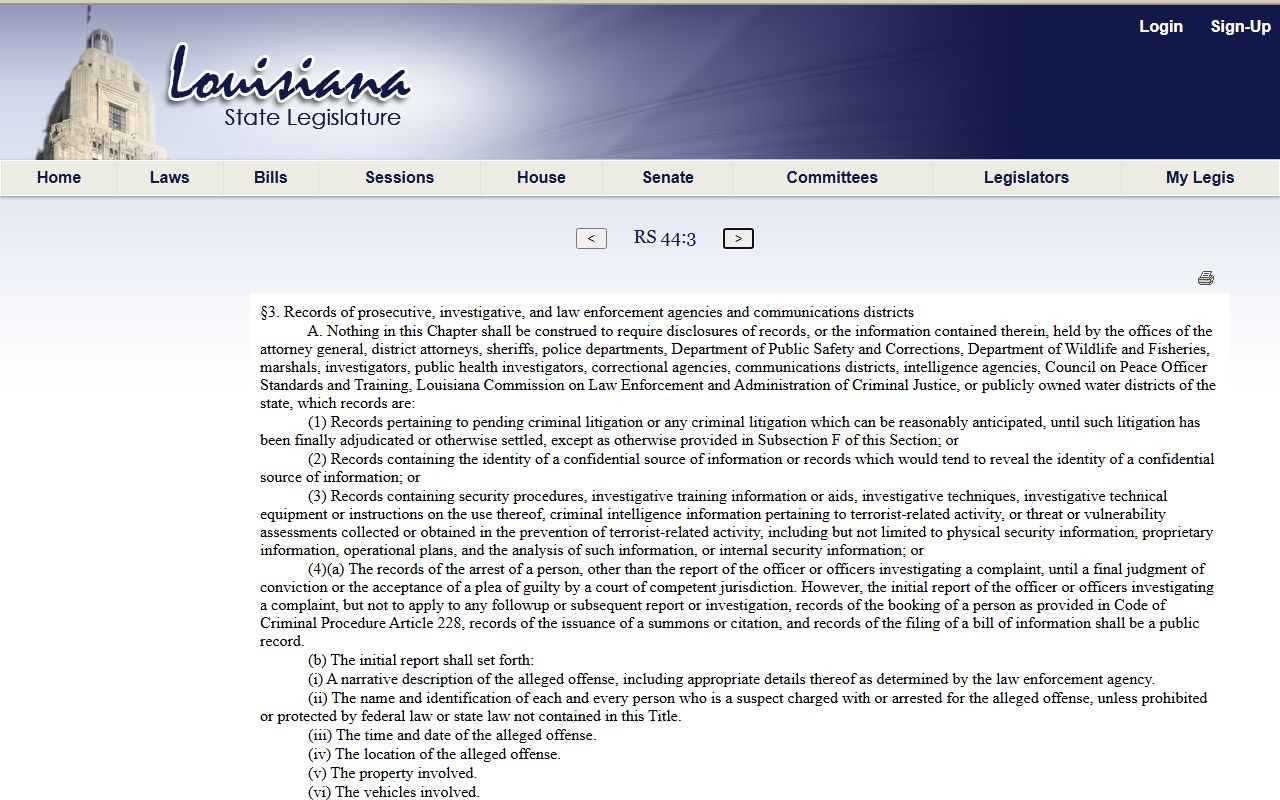
That statute is important because sheriff or prosecutor files can have limits that differ from a filed criminal court case.
Caldwell Parish Criminal Records Flow
Criminal court records are easiest to read when the case stage is clear. The first court event may not be the arrest. A filed bill of information or indictment can begin the court case. Later entries show arraignment, motions, pleas, trial settings, dispositions, and sentencing. Louisiana District Court Rule 16.0 also requires a method for making a verbatim record in felony cases and misdemeanors requiring recorded testimony.
Case flow: Charges Filed › Arraignment › Pretrial and Motions › Plea or Trial › Disposition › Sentencing
| Stage | What Happens |
|---|---|
| Charges Filed | The district attorney files a bill of information, or a grand jury indictment starts the case. |
| Arraignment | The defendant is advised of the charge and enters a plea such as guilty or not guilty. |
| Pretrial and Motions | The docket may show discovery, bond, suppression, continuance, or other motion activity. |
| Plea or Trial | The case resolves by plea, bench or jury trial, dismissal, acquittal, or other court action. |
| Sentencing | The court records punishment, probation, conditions, fines, costs, or custody terms after conviction. |
Caldwell Parish Criminal Record Fields
A Caldwell Parish criminal court record can show much more than a charge name. It can trace the case from filing to outcome. The research did not capture a live Caldwell criminal docket screen behind subscription access, so the table uses the field categories documented in clerk services, fee schedules, Louisiana district-court practice, and the court-record inventory.
| Field | What It Shows |
|---|---|
| Case Number | The court file identifier, with exact Caldwell format not located in public static sources. |
| Defendant | The person accused in the court case. |
| Charges | The filed offense or offenses, such as bill of information or indictment counts. |
| Arraignment and Plea | Entries showing advisement of charges and the defendant's plea. |
| Motions and Hearings | Docket activity for pretrial requests, continuances, bond issues, or court settings. |
| Disposition | The outcome, such as dismissed, pled, convicted, acquitted, or sentenced. |
| Sentence | Punishment, custody, probation, fines, costs, restitution, or conditions when recorded. |
Caldwell Parish Charges vs Convictions
A charge is an accusation filed into the criminal case. A conviction is a final outcome after a guilty plea, verdict, or other finding that supports sentencing. Caldwell Parish criminal court records can include charges that were amended, reduced, dismissed, nolle prossed, or resolved by acquittal. Reading only the charge name can give the wrong impression if the final disposition is ignored.
| Point | Charge | Conviction |
|---|---|---|
| Meaning | An accusation filed by the prosecutor or returned by indictment. | A case or count outcome after plea or verdict. |
| Record location | Charging document and early docket entries. | Disposition, judgment, minutes, and sentencing entries. |
| Can change | May be amended, reduced, dismissed, or dropped. | May later be affected by appeal, post-conviction relief, sealing, or expungement. |
| How to verify | Review the filed charges and later docket activity. | Read the disposition and sentence fields or certified minutes. |
Caldwell Parish Criminal Records Access
Public access to Caldwell Parish criminal court records comes through the clerk, but Louisiana law creates several limits. R.S. 44:31 provides the general right to inspect or copy public records. R.S. 44:32 covers custodian examination and copy rules. R.S. 44:3 limits some prosecutive, investigative, and law-enforcement records, including certain arrest records before final judgment or plea. Those limits can matter even when a related court case later becomes public.
The assigned source for felony expungement eligibility is Louisiana Code of Criminal Procedure article 978.
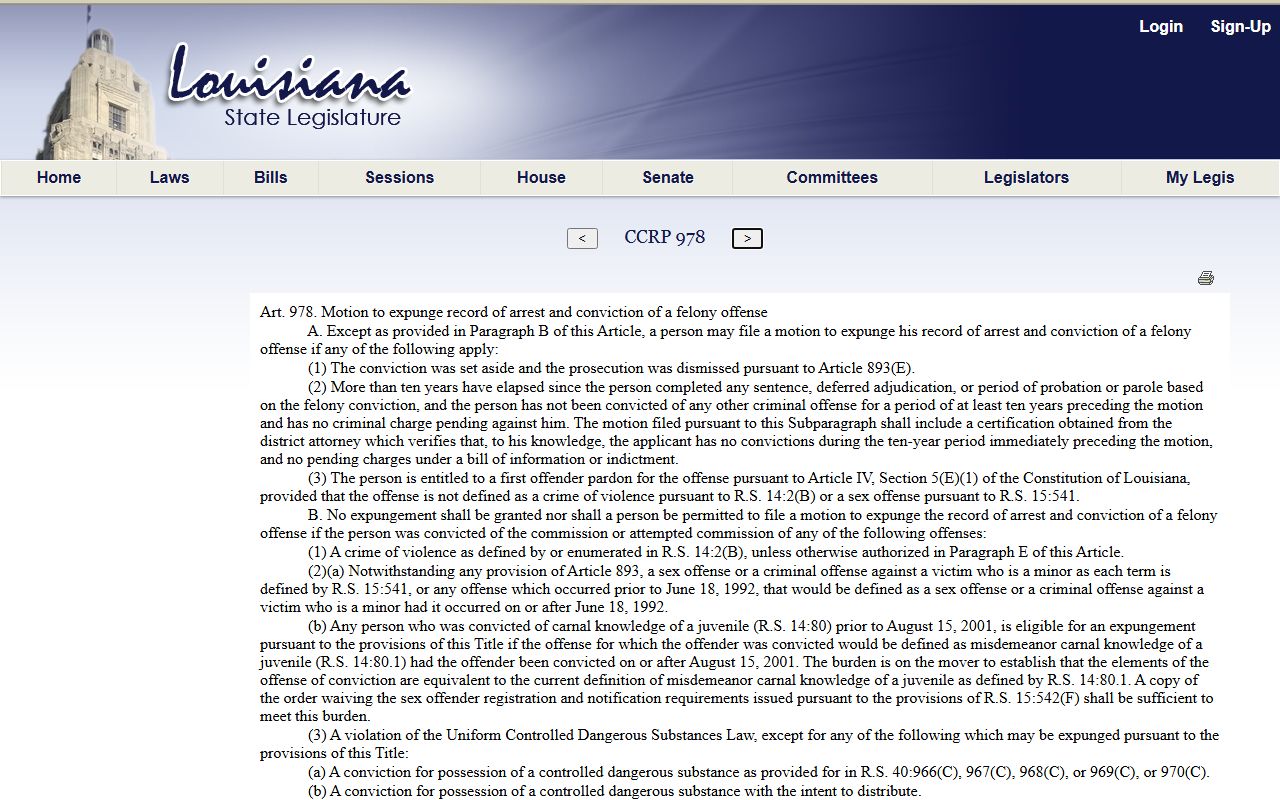
Article 978 matters when a person is checking whether a past Caldwell Parish criminal record may qualify for public access limits.
Note: Court files, sheriff files, jail roster data, and state criminal-history repositories can follow different access rules.
Sealed and Expunged Criminal Records
Louisiana expungement is a court process. A person generally files in the court tied to the arrest or conviction record, using forms such as article 925. Article 978 controls felony conviction expungement eligibility and exclusions. The research notes that some violent, sex, and other listed offenses are not eligible under ordinary rules. The applicant must account for several custodians, which may include the 37th Judicial District Court, Caldwell Parish Clerk of Court, Caldwell Parish Sheriff's Office, district attorney, and state criminal-history agencies.
The assigned article 925 source is Louisiana expungement and sealing forms.
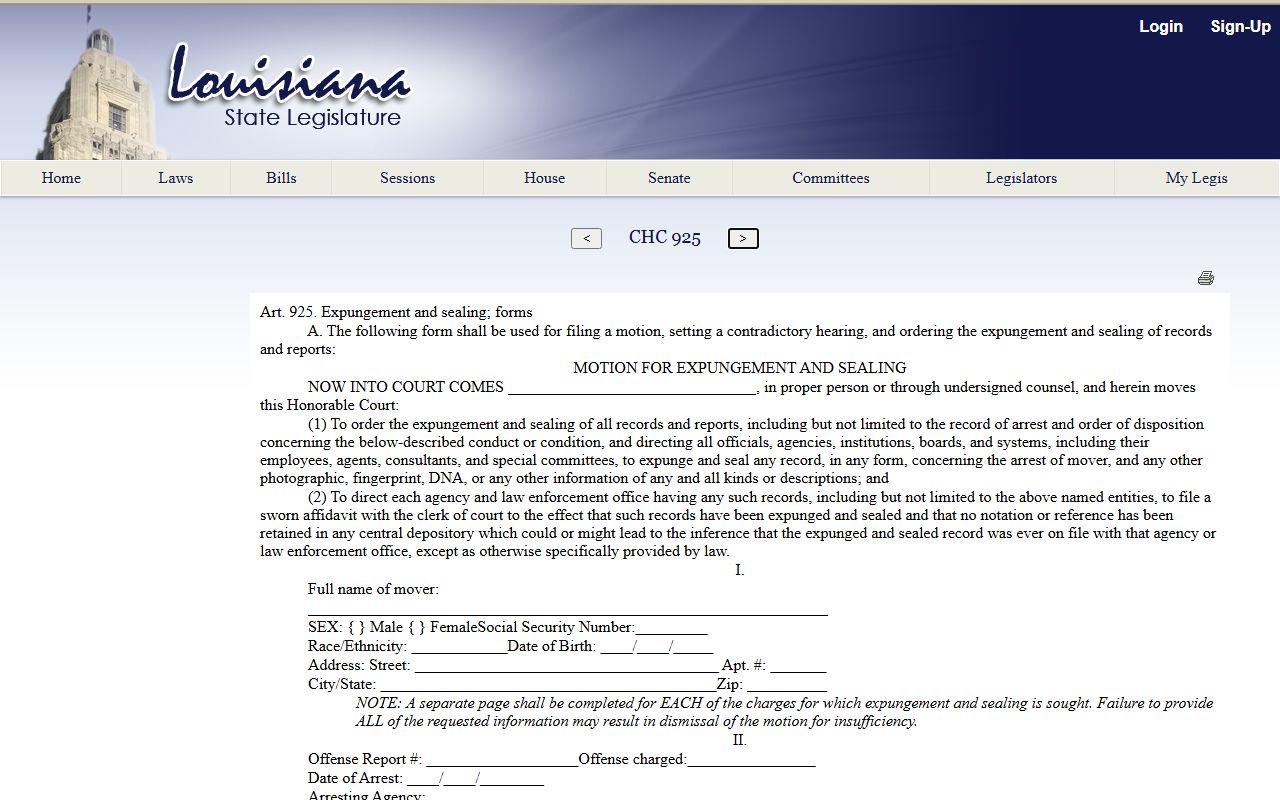
Those forms are relevant because public portal searches do not replace the court process needed to make qualifying records confidential.
| Point | Sealed | Expunged |
|---|---|---|
| Public visibility | Access is limited by court order or law. | The covered record becomes confidential for public-record purposes. |
| Government access | Courts or agencies may retain authorized access. | Law enforcement, prosecutors, courts, and some agencies may retain statutory access. |
| Process | Usually requires a court order or specific legal authority. | Requires filing under Louisiana expungement procedures. |
| Caldwell fee status | Specific local fee not located in harvested sources. | Specific local fee not located in harvested sources. |
Restricted Caldwell Parish Criminal Records
Juvenile records are a major restriction. Louisiana Children's Code article 412 says records and reports concerning juvenile court matters are confidential except traffic violations and authorized disclosures. Adoption and sensitive family matters are also not ordinary criminal public records, and personal identifiers should be redacted from public copies.
The assigned juvenile confidentiality source is Louisiana Children's Code article 412.
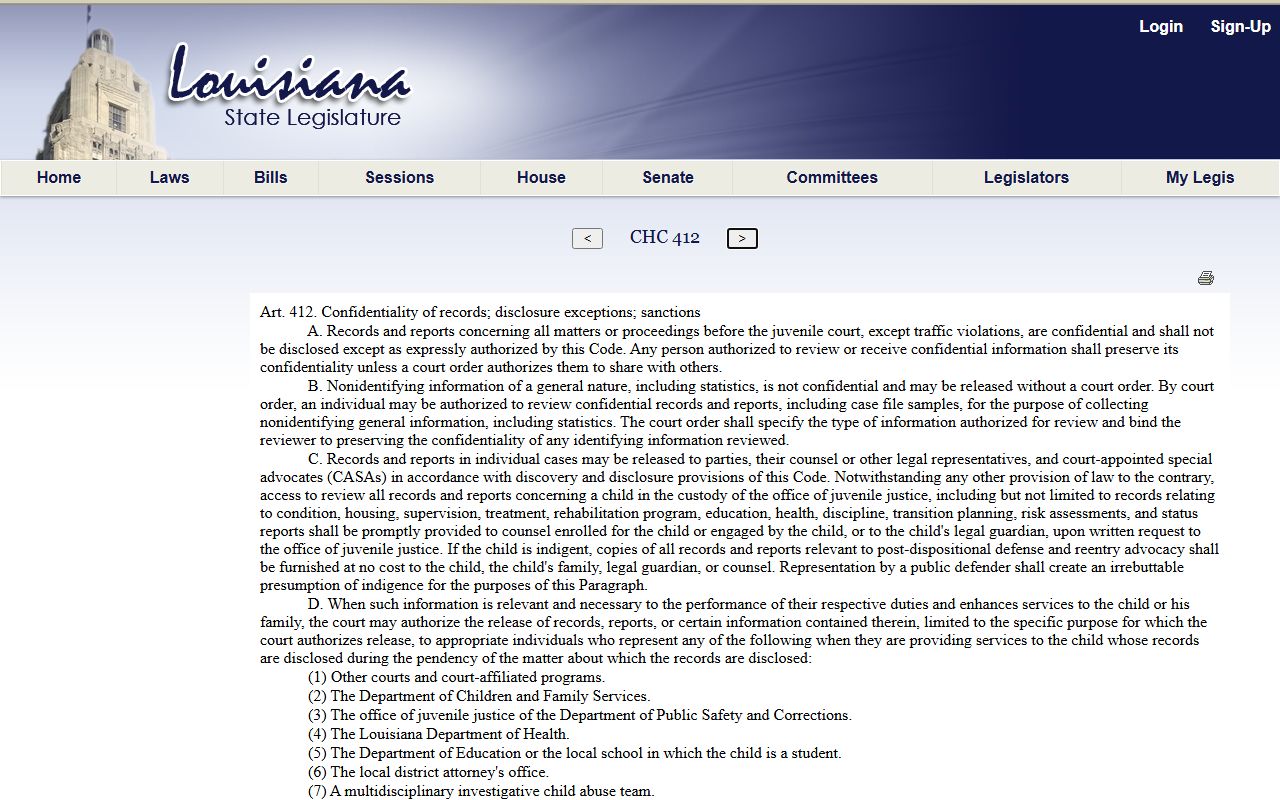
That confidentiality rule explains why juvenile criminal-type matters should not be treated as ordinary public case files.
Sex offender information follows a separate state path. The Louisiana State Police sex offender registry is an assigned source for criminal records context.
The registry is not a substitute for a criminal court file, but it is an official state channel for registry information.
The final assigned registry source is the Louisiana DPS&C sex offender registry information page.
DPS&C registry context helps separate court conviction records from state supervision and registry responsibilities.
Reading Caldwell Parish Criminal Dispositions
When reviewing Caldwell Parish criminal court records, the disposition and sentence matter more than the first charge line. A docket may show dismissed counts, amended counts, pleas, acquittals, convictions, probation terms, bench warrants, bond actions, or sentencing minutes. If the result will be used for a legal, licensing, or official purpose, request certified minutes or certified copies from the clerk.
A jail roster can show custody, and a warrant check can point to active enforcement, but the court case file is where filed charges and court outcomes are read. The broader Caldwell Parish court records process covers civil, family, probate, and other record categories beyond criminal cases.